
Develop a Mixed Voice That Gives You Freedom
Learn to navigate the bridge with greater balance, adaptability, and control so you can express yourself with confidence across your entire range.
Discover Your Voice Today
I can sing the note, but it feels difficult or forced.
My voice cracks or breaks when I sing higher.
I feel tension in my throat when reaching for high notes.
My voice sounds different every day.
My voice sounds thin or weak in the upper range.
I lose confidence when singing in front of others.
I run out of vocal stamina quickly.
Singing feels tiring even after a short time.
Common Singer’s Challenges
Why Great Singers Sound Effortless
Smooth transitions throughout your entire vocal range
Natural laryngeal stability and speech-like coordination throughout the entire range
Less tension and unnecessary effort across the range
Greater freedom and consistency from low notes to high notes
What Is Mixed Voice?
Mixed voice is not a place or specific sound in the voice.
Instead, mixed voice is the ability to maintain balance, freedom, and control as the voice moves throughout the vocal range.
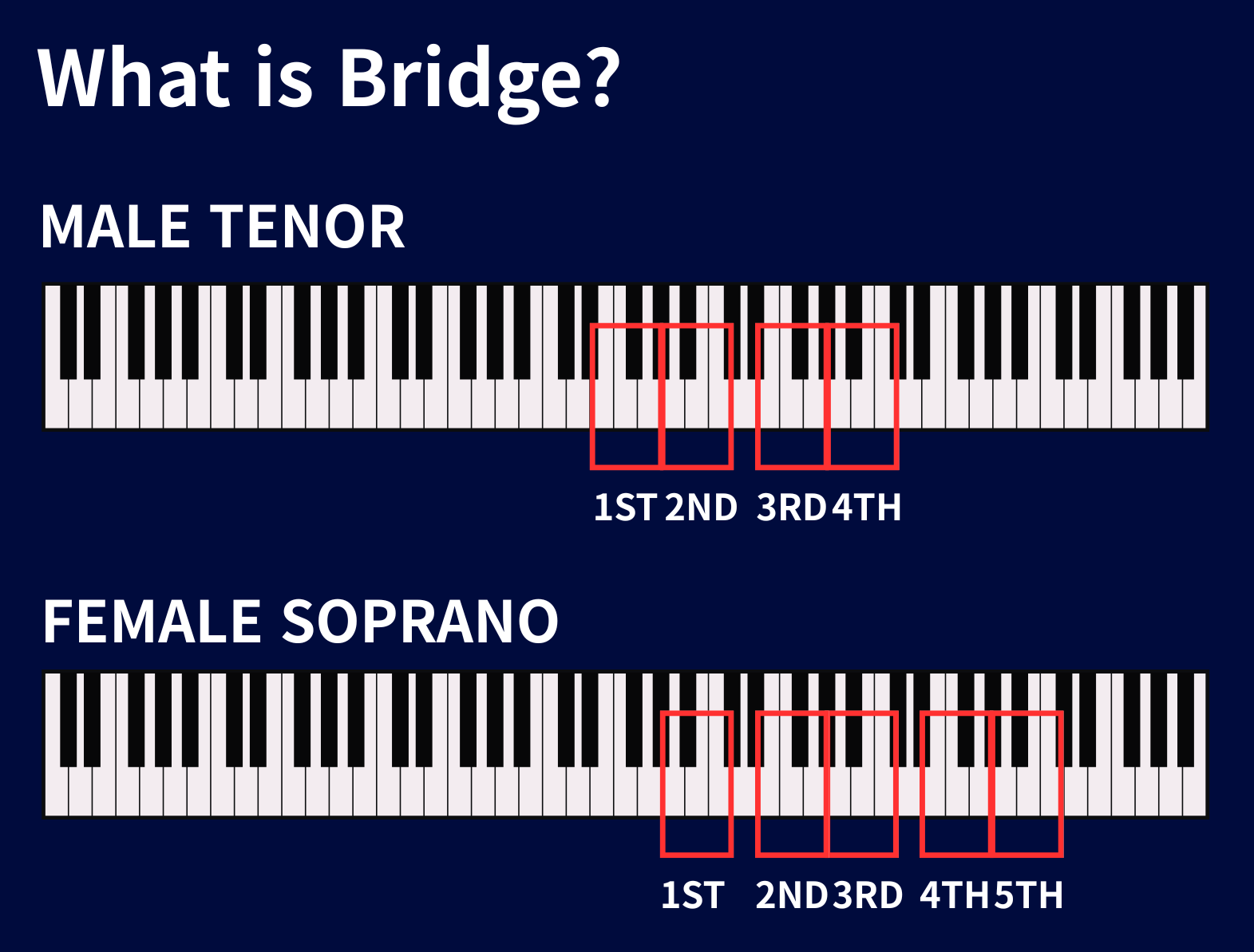
As singers move from lower notes to higher notes, they encounter transition areas often called the bridge or passaggio. These transitions are often where singers experience strain, instability, cracks, or sudden changes in vocal quality.
When the voice is well coordinated, these transitions become smoother and more efficient. The voice remains connected rather than feeling forced, disconnected, or unstable.
The Common Mistake
Many singers spend years trying to find a particular "mixed voice sound."
While this may create noticeable changes in the voice, producing a sound is not the same as developing a skill.
A singer may be able to create a mixed voice during an exercise yet struggle to use it consistently across different songs, vowels, dynamics, and musical situations.
A Different Perspective
The goal is not simply to find a mixed voice.
The goal is to develop a voice that can adapt.
One of the most important expressions of this ability is the ability to navigate the bridge efficiently while maintaining freedom, balance, and control.
A well-developed voice can respond to changing musical demands without becoming dependent on a single exercise, coordination, sensation, or sound.
Mixed voice is not the destination.
It is evidence that the voice is developing greater freedom, adaptability, and control.
Beyond Technique
Technical freedom is valuable because it creates artistic freedom.
When singers no longer need to fight their voice, they can focus on communicating emotion, intention, and meaning through music.
Technique is not the destination.
It is the foundation for artistic freedom and human connection.
How We Develop Mixed Voice
Rather than chasing a specific sound, our approach focuses on developing the underlying abilities that make efficient vocal coordination possible.
Training is designed as a progressive process that helps singers build greater freedom, adaptability, and control throughout the range.
When the right abilities are developed in the right sequence, many common vocal problems often improve naturally as a result of better coordination rather than direct correction.
The goal is not simply to produce a mixed voice.
The goal is to develop a voice that can respond reliably across different songs, styles, and musical demands.
FAQ
-
Mixed voice is often described as a vocal register, but this can sometimes create confusion.
Rather than thinking of mixed voice as a separate register, it is often more useful to think of it as a coordination that allows the voice to transition efficiently between different vocal qualities while maintaining balance, freedom, and control.
This is why mixed voice is commonly discussed in relation to the bridge or passaggio, where coordination challenges become most noticeable.
As vocal development progresses, singers learn to maintain these coordinations throughout a larger portion of the vocal range rather than relying on a single register or vocal quality.
-
Producing a sound during an exercise is not necessarily the same as being able to use that coordination in a song.
Songs introduce changing vowels, dynamics, pitches, rhythms, and emotional demands that place different demands on the voice.
A singer may learn to produce a mixed voice in a controlled exercise but still need to develop the adaptability required to maintain that coordination in real musical situations.
The goal is not simply to create a sound. The goal is to develop a voice that can respond reliably under changing conditions.
-
Yes, but not simply because it allows singers to sing higher.
As singers move higher in their range, the voice must gradually adjust and reorganize in order to remain efficient. When these adjustments do not occur, singers often experience excessive tension, strain, instability, or sudden breaks in the voice.
Developing mixed voice helps singers maintain better balance, freedom, and control as they move into higher notes.
Rather than forcing chest voice higher or abruptly switching into a disconnected head voice, singers learn to coordinate the voice more efficiently throughout the range.
The goal is not just to reach higher notes.
The goal is to sing higher notes with greater ease, consistency, and musical freedom.
-
Voice cracks often occur when the voice struggles to adjust efficiently as pitch increases.
As singers move through the bridge (passaggio), the voice must gradually reorganize in order to maintain balance, freedom, and control. When these coordinations are not yet well developed, the voice may become unstable, resulting in sudden breaks, cracks, or changes in vocal quality.
For many singers, cracking is not simply a sign of weakness or failure. It is often a sign that the voice is encountering a coordination challenge that has not yet been fully developed.
Rather than forcing the voice through the bridge, effective training focuses on developing the abilities required to navigate these transitions more efficiently.
As coordination improves, the voice typically becomes more connected, stable, and reliable throughout the range.